
Land Use Planning and Approvals Act 1993: The previous operator had a development permit which is still current, you may wish to advise Council of the change of ownership
Environmental Management and Pollution Control Act 1994: Operator has a Permit Conditions – Environmental (PCE) 8726 (r1) attached to the council permit which includes a series of conditions. Responsibility for maintaining compliance with these conditions whether the previous operator did so or not. Condition L04 requires the responsible person to notify the regulator if they are no longer responsible for the activity. regulator (Environment Protection Authority (EPA)) of the change
Mineral Resources Development Act 1995: The quarry is covered by a mining lease 1755P/M. The mining lease also has conditions. Operator has responsible for compliance. The mining lease is transferred to the operating entity. This involve an application and what is termed a ‘mining plan’ which describes the activity and includes a quarry plan to show how the resource will be fully developed in an efficient manner over time.
Work Health and Safety Act 2012 and Mines Work Health and Safety (Supplementary Requirements) Act 2012: The Work Health and Safety Regulations 2022 and the Work Health and Safety (Transitional) Regulations 2022 replace the Work Health and Safety Regulations 2012
The mining lease is transferred to the operating entity. This involve an application and what is termed a ‘mining plan’ which describes the activity and includes a quarrying plan to show how the resource will be fully developed in an efficient manner over time
The operators have a comprehensive mining management plan approved by and under lease permit condition requirements, flora and fauna survey conducted and continue to be monitored to ensure that the quarry is low risk to disturbing any threatened flora, fauna or communities.
The Operator has constructed sediment retention basin to prevent uncontrolled runoff from the quarry entering the receiving environment.
Weed incursion risks are monitored and controlled for ongoing treatment by introducing weed and disease hygiene management measures.
Specialised Consulting Contractors are commissioned by Highland Mineral Resources to conduct monitoring and risk assessment for weeds and Phytophthora cinnamomi (Phytophthora) at the Arthurs Lake Quarry and adjacent internal property areas.
Monitoring for weed species entering and or present on-site, also carry out mitigation control methods and report any necessary implementation actions required, and evaluates the likelihood of Phytophthora occurring. monitoring protocols for early detection and recommends management actions to prevent or limit the pathogen’s spread if detected and ongoing weed control for quarrying processing and cartage equipment hygiene measures.
The Operator had blasting noise modelling undertaken that shows no existing proximity dwellings will experience air-blast overpressure or ground vibration in excess of acceptable limits.
A mechanical noise study found that under worst case scenario condition requirements of the Quarry Code of Practice with regard to mechanical noise will be within the required limits.
The existing surrounding eucalypt forest and woodland that screens the quarry from Arthurs Lake Road are supplemented with an additional planting to ensure that the quarry remains concealed from the direction of Arthurs Lake.
Arthurs Lake Quarry can continue to operate at an annual production rate without any adverse effects on the receiving environmental or the local community.
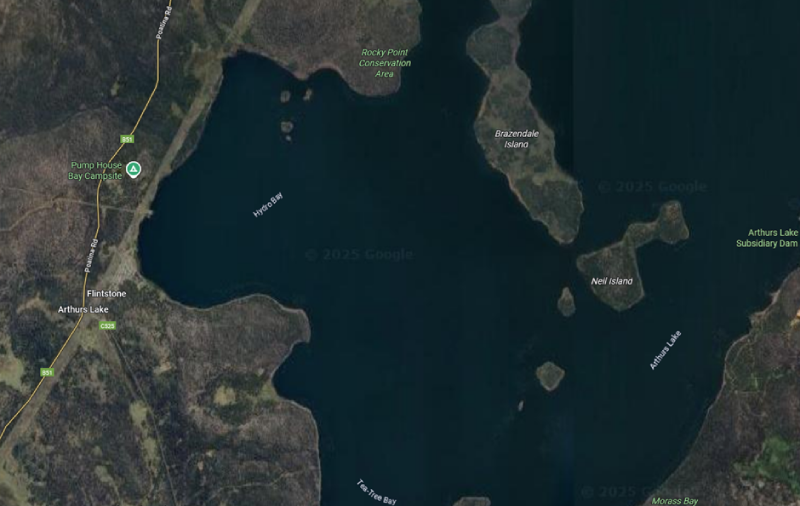
81 Arthurs Lake Road Arthurs Lake
Highland Mineral Resources are in the process of developing and operating ISO quality management systems
The Operator is required to appoint a Site Senior Officer and notify Work Safe Tasmania
The SSO is responsible for the health and safety of anyone working on the site (including contractors).
HMR conduct hazard risk assessment and mitigate OHS risks by developing a site management safety system and introducing ongoing developing working JSEA’s, (Job Safety & Environmental Analysis) SWMS (Safe Work Method Statement) including incident reporting and internal auditing review.
Highland Mineral Resources are committed to undertaking sustainable best practices within the quarrying industry via research in pursuit of latest technology processes and procedures
Our quarry being within a 110 ha woodland property provides the future possibility of potential Natural Carbon Sequestration creating offset carbon neutral construction materials that met the needs of the present market without compromising future generation requirements
Focus on supplying local markets, traditionally supplied by distant non-local or no compliant operators.
By providing proximity to the local infrastructure developments, certified materials can and should be sourced as close as possible to the location of their use. To achieve this, it is essential to ensure material and environmental conditions are met and compliant for the construction industry requirements
Our focus is to lower carbon emission per tonne delivered.
HMR are exploring and developed processes allowing segregation of direct blasted material by existing size selection via Primary Selection Screening Operations prior to introducing Jaw and Cone crushing operations for medium to large sized product materials.
Our goal is to maximise internal mobile plant and equipment use by efficient internal process planning operations in moving/ segregating raw material lowering emissions per tonne produced.
81 Arthurs Lake Road, Arthurs Lake
Copyright © 2025 Highland Mineral Resources | All Rights Reserved | Design & Developed by WBH Digital Solutions Pvt. Ltd.